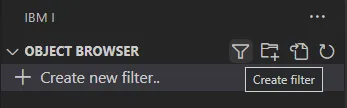
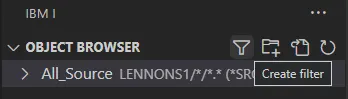
Click on the + Create new filter prompt to create your first filter (or click on the filter icon):
The Object Browser allows you to interact with libraries, files, source files, programs and other types of objects. Subset the objects you want to work with by creating a filter or filters.
Click on the + Create new filter prompt to create your first filter (or click on the filter icon):
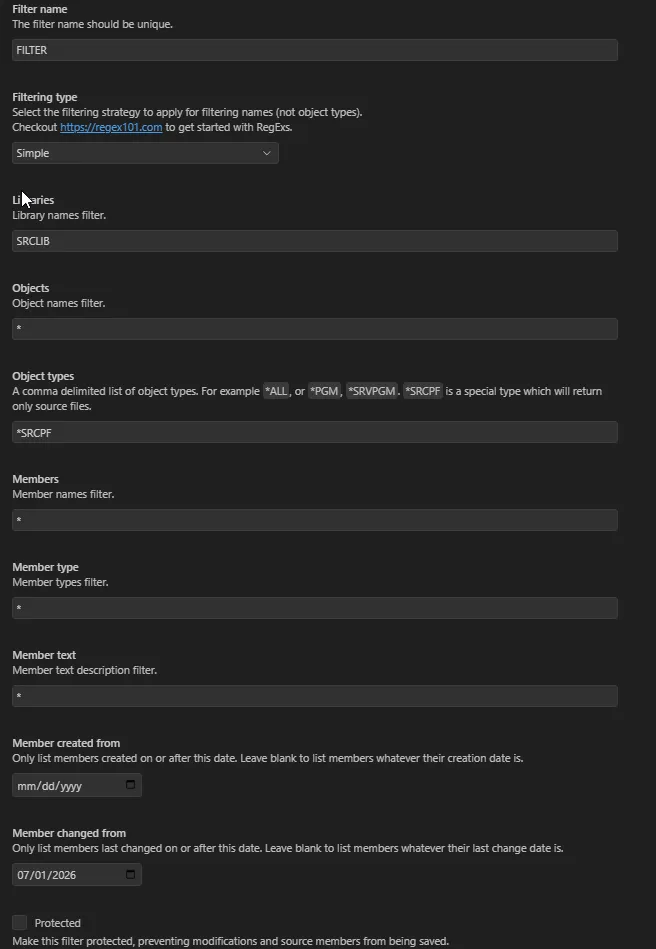
Complete the new filter dialog. The explanatory text in the Create Filter dialog explains the options.
Click ‘Save settings’ to create the new filter.
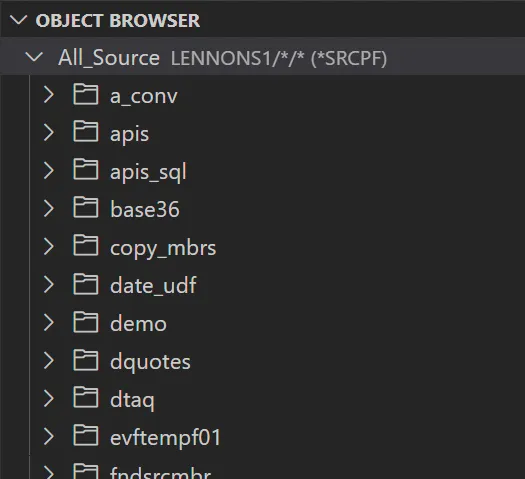
The above filter example lists all source files in library LENNONS1:
The filter dialog has the following options:
| Option | Description |
|---|---|
| Filter name | The name shown in the browser. It must be unique. |
| Filtering type | The strategy used to match names and member text (not object types).Simple: a comma-separated list of multi-generic values, e.g. *, Q* or *CL*SRC*. A single *, *ALL or a blank value returns everything.Regex: a single regular expression. |
| Libraries | Filters the library names. |
| Objects | Filters the object names. |
| Object types | A comma delimited list of object types, e.g. *ALL, or *PGM, *SRVPGM. *SRCPF is a special type which returns only source files. |
| Members | Filters the source member names. |
| Member type | Filters the source member types, e.g. RPGLE, SQLRPGLE. |
| Member text | Filters the source members on their text description. The match is case insensitive. Leave * (or *ALL) to list the members regardless of what their text is. |
| Member created from | Only lists the source members created on or after this date. Leave blank to list the members regardless of what their creation date is. |
| Member changed from | Only lists the source members last changed on or after this date. Leave blank to list the members regardless of what their last change date is. |
| Protected | Makes the filter read only: it cannot be modified and the source members it lists cannot be saved. |
The Member text filter follows the Filtering type of the filter, so with Simple you can subset on a fragment of the description (*PAYROLL*) or list several ones separated by a comma (*PAYROLL*, *INVOICE*), while with Regex the whole text is matched against your regular expression.
Both dates are picked with a date picker and are stored in the YYYY-MM-DD format. They are inclusive (a member created exactly on the given day is listed) and can be used together, for example to list only the members created since the beginning of the year and changed in the last week. A value which is not a valid date is cleared when the filter is saved.
By default, the definition of a filter is shown both next to the filter name (the description) and in the tooltip which appears when hovering the filter. This is controlled by the Code for IBM i > Object Browser: Filter Details global setting:
| Value | Result |
|---|---|
both (default) | The details are shown next to the filter name and in its hover. |
tooltip | The details are only shown in the filter’s hover. |
description | The details are only shown next to the filter name. |
The description is built as library/object/member.memberType (object types), followed by the member text between square brackets and by the date subsetting between curly brackets when they are set, e.g.:
MYFILTER LENNONS1/*ALL/*ALL.* (*SRCPF) [*PAYROLL*] {created ≥ 2026-01-01, changed ≥ 2026-07-01}Changing the setting refreshes the Object Browser right away.
To create another filter, click the filter icon to open up the new filter dialog.
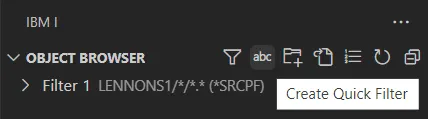
To quickly create filters without having to fill out the filter dialog, click on the Create Quick Filter icon. When prompted, enter a filter that matches one of the following formats:
LIB*LIB/OBJ/MBR.MBRTYPE (OBJTYPE)
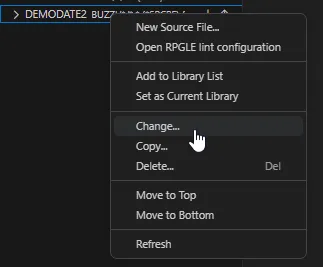
Changing a filter definition is quick and easy. Just right click on the filter and chose Change to open up the filter dialog. Or chose Delete to remove the filter definition.
Single File Filter
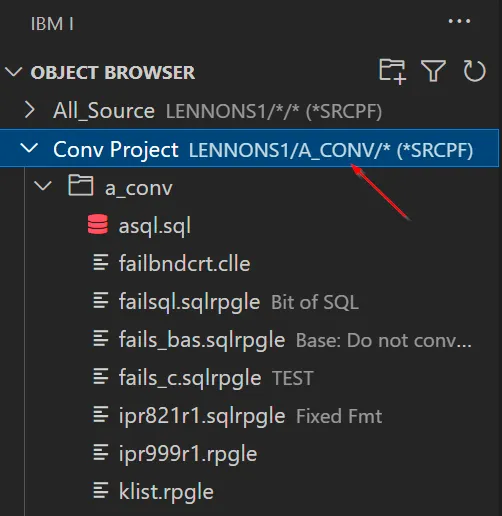
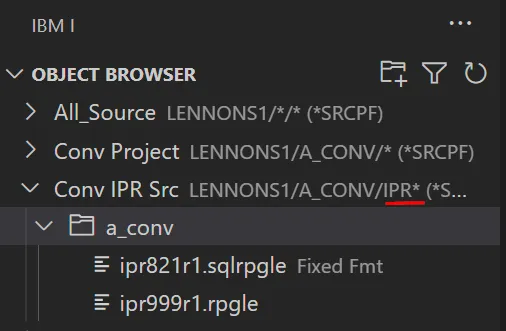
Subsetted source member example
A single source file files subsetting just some members:
Non Source Example
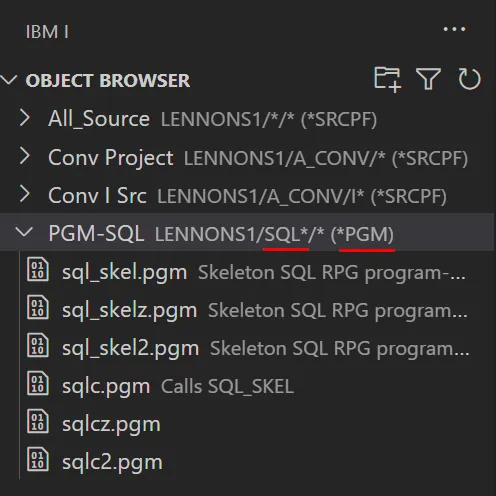
Some programs in a library: