
Configuring Tests
Compile Configuration
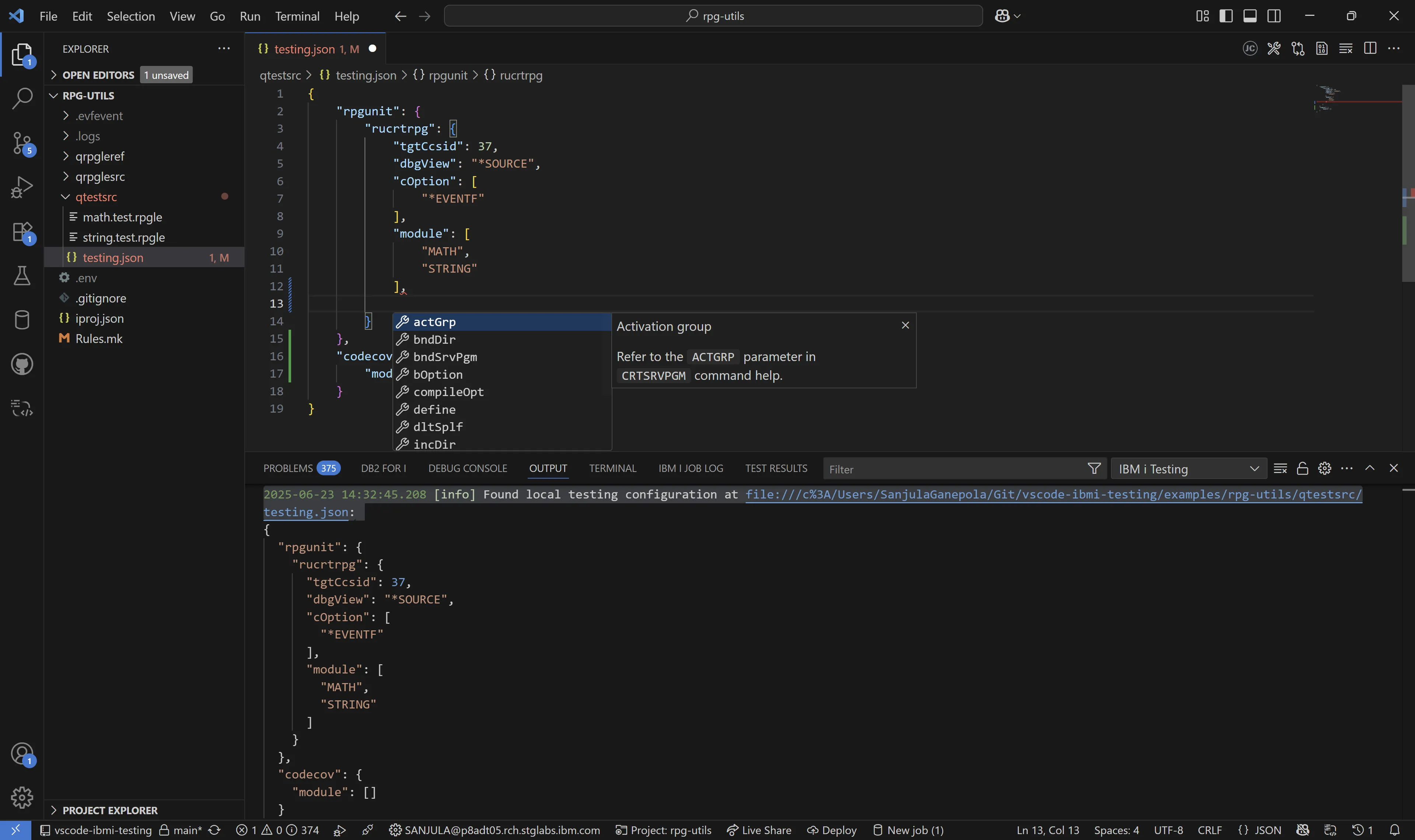
The process of defining how to compile your tests is greatly simplified using a configuration file called testing.json. This file allows you to specify the parameters for the RPGUnit compile commands (RUCRTRPG and RUCRTCBL) and the code coverage command (CODECOV) in JSON format. The scope in which these parameters are applied is determined by the location of the testing.json file and depends on whether you are working with local files or source members.
Local Files
The following hierarchy is used to determine the configuration for local files:
<directory>/testing.json: This is a directory level configuration file that will apply to all tests in that directory..vscode/testing.json: This is a global configuration file that will apply to all tests in that project. Parameters not set at the directory level will be inherited from this global configuration.
Shown below is an example of a project structure with the testing.json file at the global and directory level:
Directorymy-project
Directory.vscode
- testing.json Global configuration
Directoryqsqlsrc
- employee.sql
Directoryqrpglesrc
- utilsA.rpgle
- utilsB.rpgle
- employee.rpgle
Directoryqtestsrc
Directoryutils
- testing.json Directory level configuration
- utilsA.test.rpgle
- utilsB.test.rpgle
- employee.test.rpgle
Source Members
The following hierarchy is used to determine the configuration for source members:
<sourceFile>/testing.json: This is a source file level configuration file that will apply to all tests in that source file.VSCODE.FILE/testing.json: This is a global configuration file that will apply to all tests in that library. Parameters not set at the source file level will be inherited from this global configuration.
Shown below is an example of a project structure with the testing.json file at the global and source file level:
DirectoryMYUSER.LIB
DirectoryVSCODE.FILE
- TESTING.JSON Global configuration
DirectoryQSQLSRC.FILE
- EMPLOYEE.SQL
DirectoryQRPGLESRC.FILE
- EMPLOYEE.RPGLE
- UTILSA.RPGLE
- UTILSB.RPGLE
DirectoryQTESTSRC.FILE
- EMPLOYEE_T.RPGLE
DirectoryUTILTESTS.FILE
- TESTING.JSON Source file level configuration
- UTILSA_T.RPGLE
- UTILSB_T.RPGLE
Default Configuration
Use the following steps to create a default configuration for your project:
- Create a
testing.jsonfile or source member in the desired location. - Press
Ctrl+Spaceand select theIBM i Testing Configurationoption to generate the default configuration:{"rpgunit": {"rucrtrpg": {"tgtCcsid": "*JOB","dbgView": "*SOURCE","rpgPpOpt": "*LVL2","cOption": ["*EVENTF"]},"rucrtcbl": {"tgtCcsid": "*JOB","dbgView": "*SOURCE","cOption": ["*EVENTF"]},"rucalltst": {"order": "*API","libl": "*CURRENT","jobD": "*DFT","detail": "*BASIC","output": "*ALLWAYS","rclRsc": "*NO","onFailure": "*ABORT"}},"codecov": {"module": []}} - Use
Ctrl+Spacewithin any of the commands to see the available parameters and their descriptions.
Execution Configuration
When it comes time to executing the tests, the extension essentially runs the RUCALLTST command provided by RPGUnit. The parameters for this command modify how the tests are executed, such as the order to run the tests and whether to reclaim resources after each test case. These parameters can be configured in the either the VS Code settings or in the testing.json configuration file.
VS Code Settings
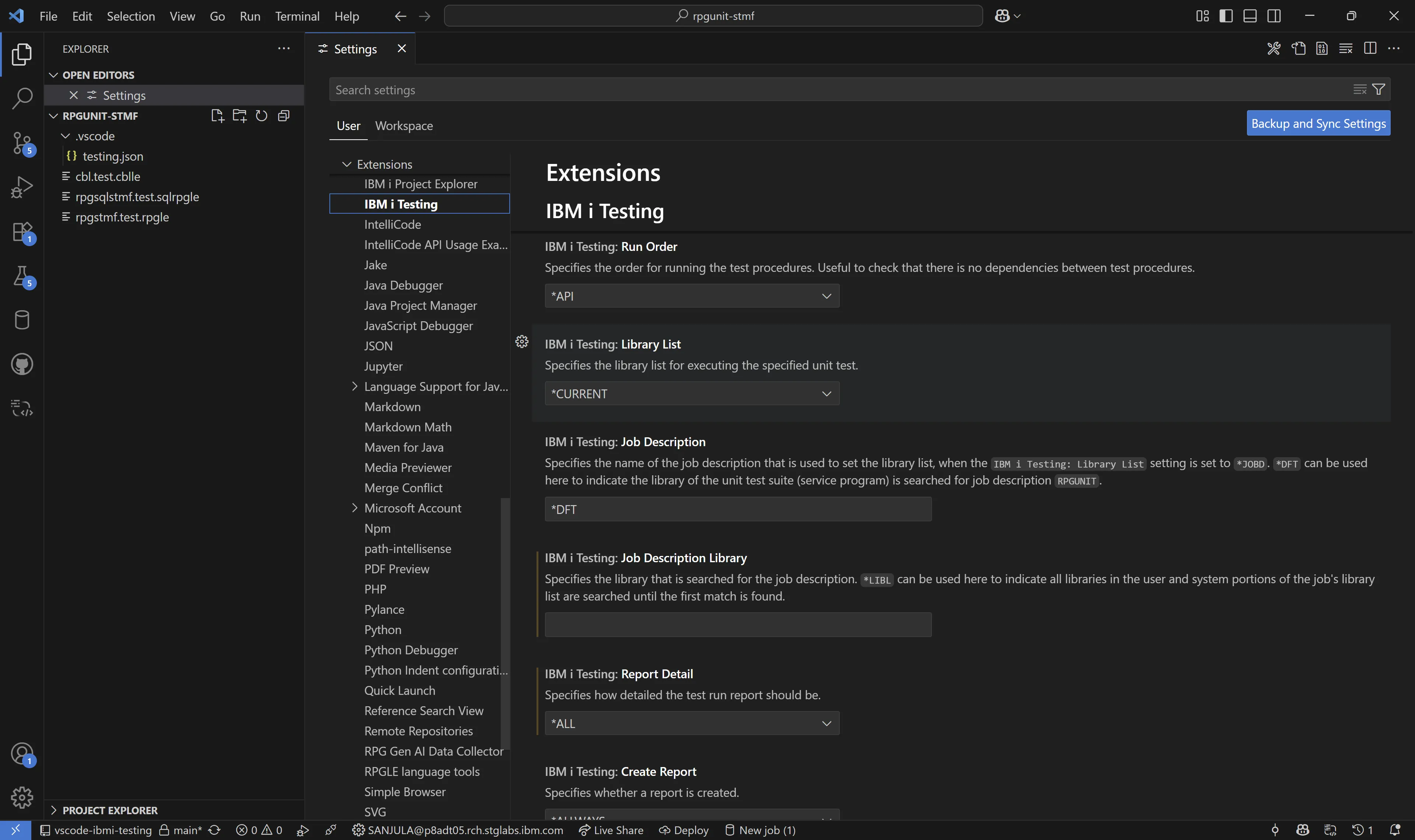
Configuring the execution parameters via the VS Code settings is the suggested option if you prefer to treat these parameters as preferences that will allow each developer to configure for how tests are executed. These settings can be found by going to the extension’s settings and searching for IBM i Testing (from Run Order to Reclaim Resources).
Configuration File
The alternative option is to configure the execution parameters in the testing.json configuration file (the same one used for compile command configuration). This is useful if you want to enforce specific execution parameters to be used by all developers working on a project.
Here is an example with all execution parameters set in the testing.json file:
{ "rpgunit": { "rucalltst": { "order": "*API", "libl": "*CURRENT", "jobD": "*DFT", "detail": "*BASIC", "output": "*ALLWAYS", "rclRsc": "*NO", "onFailure": "*ABORT" } }}Compile, Execution, and Coverage Parameters
| Parameter | Name | Description | Default |
|---|---|---|---|
tstPgm | Test program | Specifies the name of the test program (*SRVPGM) to create. By default, this will be set to &OPENLIB/&OPENMBR for source members and &CURLIB/&SHORTNAME for local files. | |
srcFile | Source file | Specifies the name of the source file containing a member with the same name as TSTPGM. By default, this will be set to &OPENLIB/&OPENSPF for source members. | |
srcMbr | Source member | Specifies the name of the member containing the source code to be compiled. By default, this will be set to &OPENMBR for source members. | |
srcStmf | Source stream file | Specifies the path name of the stream file containing the source code to be compiled. By default, this will be set to &FULLPATH for local files. | |
text | Text description | Allows you to enter text that briefly describes the RPGUnit test case and its function. | |
cOption | Compile options | Refer to the OPTION parameter in CRTRPGMOD command help. | *EVENTF |
dbgView | Debugging views | Refer to the DBGVIEW parameter in CRTRPGMOD command help. | *SOURCE |
bndSrvPgm | Bind service program | Refer to the BNDSRVPGM parameter in CRTSRVPGM command help. | |
bndDir | Binding directory | Refer to the BNDDIR parameter in CRTSRVPGM command help. | |
bOption | Binding options | Refer to the OPTION parameter in CRTSRVPGM command help. | |
define | Define condition names | Specifies condition names that are defined before the compilation begins. Using the parameter DEFINE(condition-name) is equivalent to coding the /DEFINE condition-name directive on the first line of the source file. | |
dltSplf | Delete spooled files | Specifies if all spooled files (compile listing) created by the object creations commands are deleted on success. | |
actGrp | Activation group | Refer to the ACTGRP parameter in CRTSRVPGM command help. | |
module | Module | Refer to the MODULE parameter in CRTSRVPGM command help. | |
rpgPpOpt | Pre-compiler RPGPPOPT | Refer to the RPGPPOPT parameter in CRTSRVPGM command. | *LVL2 |
pOption | Pre-compiler OPTIONS | Refer to the OPTION parameter in CRTSQLRPGI command help. | |
compileOpt | Pre-Compiler COMPILEOPT | Refer to the COMPILEOPT parameter in CRTSQLRPGI command help. | |
tgtRls | Target release | Refer to the TGTRLS parameter in CRTSRVPGM command help. | |
incDir | Include directory | Specifies one or more directories to add to the search path used by the compiler to find copy files. The compiler will search the directories specified here if the copy files in the source program can not be resolved. | |
tgtCcsid | Target CCSID | Specifies the CCSID that the compiler uses to read the source files. | *JOB |
wrapperCmd | Wrapper Command | Specifies a custom command to wrap the RUCRTRPG command. |
| Parameter | Name | Description | Default |
|---|---|---|---|
tstPgm | Test program | Specifies the name of the test program (*SRVPGM) to create. By default, this will be set to &OPENLIB/&OPENMBR for source members and &CURLIB/&SHORTNAME for local files. | |
srcFile | Source file | Specifies the name of the source file containing a member with the same name as TSTPGM. By default, this will be set to &OPENLIB/&OPENSPF for source members. | |
srcMbr | Source member | Specifies the name of the member containing the source code to be compiled. By default, this will be set to &OPENMBR for source members. | |
srcStmf | Source stream file | Specifies the path name of the stream file containing the source code to be compiled. By default, this will be set to &FULLPATH for local files. | |
text | Text description | Allows you to enter text that briefly describes the RPGUnit test case and its function. | |
cOption | Compile options | Refer to the OPTION parameter in CRTCBLMOD command help. | *EVENTF |
dbgView | Debugging views | Refer to the DBGVIEW parameter in CRTCBLMOD command help. | *SOURCE |
bndSrvPgm | Bind service program | Refer to the BNDSRVPGM parameter in CRTSRVPGM command help. | |
bndDir | Binding directory | Refer to the BNDDIR parameter in CRTSRVPGM command help. | |
bOption | Binding options | Refer to the OPTION parameter in CRTSRVPGM command help. | |
define | Define condition names | Specifies condition names that are defined before the compilation begins. Using the parameter DEFINE(condition-name) is equivalent to coding the /DEFINE condition-name directive on the first line of the source file. | |
dltSplf | Delete spooled files | Specifies if all spooled files (compile listing) created by the object creations commands are deleted on success. | |
actGrp | Activation group | Refer to the ACTGRP parameter in CRTSRVPGM command help. | |
module | Module | Refer to the MODULE parameter in CRTSRVPGM command help. | |
pOption | Pre-compiler OPTIONS | Refer to the OPTION parameter in CRTSQLCBLI command help. | |
compileOpt | Pre-Compiler COMPILEOPT | Refer to the COMPILEOPT parameter in CRTSQLCBLI command help. | |
tgtRls | Target release | Refer to the TGTRLS parameter in CRTSRVPGM command help. | |
incDir | Include Directory | Specifies one or more directories to add to the search path used by the compiler to find copy files. The compiler will search the directories specified here if the copy files in the source program can not be resolved. | |
tgtCcsid | Target CCSID | Specifies the CCSID that the compiler uses to read the source files. | *JOB |
wrapperCmd | Wrapper Command | Specifies a custom command to wrap the RUCRTCBL command. |
| Parameter | Name | Description | Default |
|---|---|---|---|
module | Module | Specifies programs or service programs and optionally modules to include for code coverage. | |
testId | Test ID | ||
exclude | Exclude | Objects to exclude |
| Parameter | Name | Description | Default |
|---|---|---|---|
tstPgm | Test program | Specifies the name of the test program (*SRVPGM). By default, this will be set to &OPENLIB/&OPENMBR for source members and &CURLIB/&SHORTNAME for local files. | |
order | Run Order | Specifies the order for running the test procedures. Useful to check that there is no dependencies between test procedures. | *API |
libl | Library List | Specifies the library list for executing the specified unit test. | *CURRENT |
jobD | Job Description | Specifies the name of the job description that is used to set the library list, when the IBM i Testing: Library List setting is set to *JOBD. *DFT can be used here to indicate the library of the unit test suite (service program) is searched for job description RPGUNIT. | *DFT |
detail | Report Detail | Specifies how detailed the test run report should be. | *BASIC |
output | Create Report | Specifies whether a report is created. | *ALLWAYS |
rclRsc | Reclaim Resources | Specifies when to reclaim resources. Resources, such as open files, can be reclaimed after each test case or at the end of the test suite. This option is useful if the test suite calls OPM programs, which do not set the *INLR indicator. | *NO |
onFailure | On Failure | Specifies test execution behavior after a failing assertion. | *ABORT |
wrapperCmd | Wrapper Command | Specifies a custom command to wrap the RUCALLTST command. |
Advanced Configuration
Some compile and execution configuration parameters (TSTPGM, SRCFILE, SRCMBR, SRCSTMF) are special because the extension typically manages and sets them for you. This is because they can be determined by the extension based on what tests are being compiled and executed. However, to provide maximum flexibility in configuring even these parameters, users can still do so via the testing.json file. A simple use case could be that you want to build your source member tests into your current library instead of the library containing the source.
Under the covers, the extension has default values for these special parameters along with supported variables based on whether you are working with local files or source members. The defaults below can be overwritten in the testing.json file:
{ "rpgunit": { "rucrtrpg": { "tstPgm": "&OPENLIB/&OPENMBR", "srcFile": "&OPENLIB/&OPENSPF", "srcMbr": "&OPENMBR" }, "rucalltst": { "tstPgm": "&OPENLIB/&OPENMBR" } }}Supported Variables:
&CURLIB: Current library, changeable in the Library List&OPENLIB: Library name where the test source member lives&OPENSPF: Source file name where the test source member lives&OPENMBR: Name of the test source member
{ "rpgunit": { "rucrtrpg": { "tstPgm": "&CURLIB/&SHORTNAME" "srcStmf": "&FULLPATH", }, "rucalltst": { "tstPgm": "&CURLIB/&SHORTNAME" } }}Supported Variables:
&CURLIB: Current library, changeable in the Library List&NAME: Name of the test file&SHORTNAME: Shortened name of the test file (based on rules here)&FULLPATH: Full path of the test file on the remote system
Vendor Integration
The wrapperCmd parameter in the RUCRTRPG/RUCRTCBL/RUCALLTST specifications are not actual parameters of the RPGUnit commands, but rather are provided by the extension to allow wrappering them. This is primarily used when integrating RPGUnit with other vendor tools.
Example testing.json configuration:
{ "rpgunit": { "rucrtrpg": { "tgtCcsid": "*JOB", "dbgView": "*SOURCE", "cOption": [ "*EVENTF" ], "wrapperCmd": { "cmd": "MYLIB/MYCMD TSTCMD", "params": { "desc": "My description" } } }, "rucalltst": { "wrapperCmd": { "cmd": "MYLIB/MYCMD CALLCMD", "params": { "desc": "My description" } } } }}Compile Command:
MYLIB/MYCMD TSTCMD(RPGUNIT/RUCRTRPG TSTPGM(MYUSER/TEMPDET)SRCSTMF('/home/MYUSER/builds/ibmi-company_system/qtestsrc/empdet.test.sqlrpgle')TGTCCSID(*JOB) DBGVIEW(*SOURCE) COPTION(*EVENTF) RPGPPOPT(*LVL2)INCDIR('''/home/MYUSER/builds/ibmi-company_system''')) DESC('My description')Execution Command:
MYLIB/MYCMD CALLCMD(RPGUNIT/RUCALLTST TSTPGM(MYUSER/TEMPDET) ORDER(*REVERSE)DETAIL(*ALL) OUTPUT(*ALLWAYS) LIBL(*CURRENT) JOBD(*DFT) RCLRSC(*NO)XMLSTMF('/tmp/testing/vscode-ibmi-testing/RPGUNIT/TEMPDET_1751646914682.xml'))DESC('My description')